
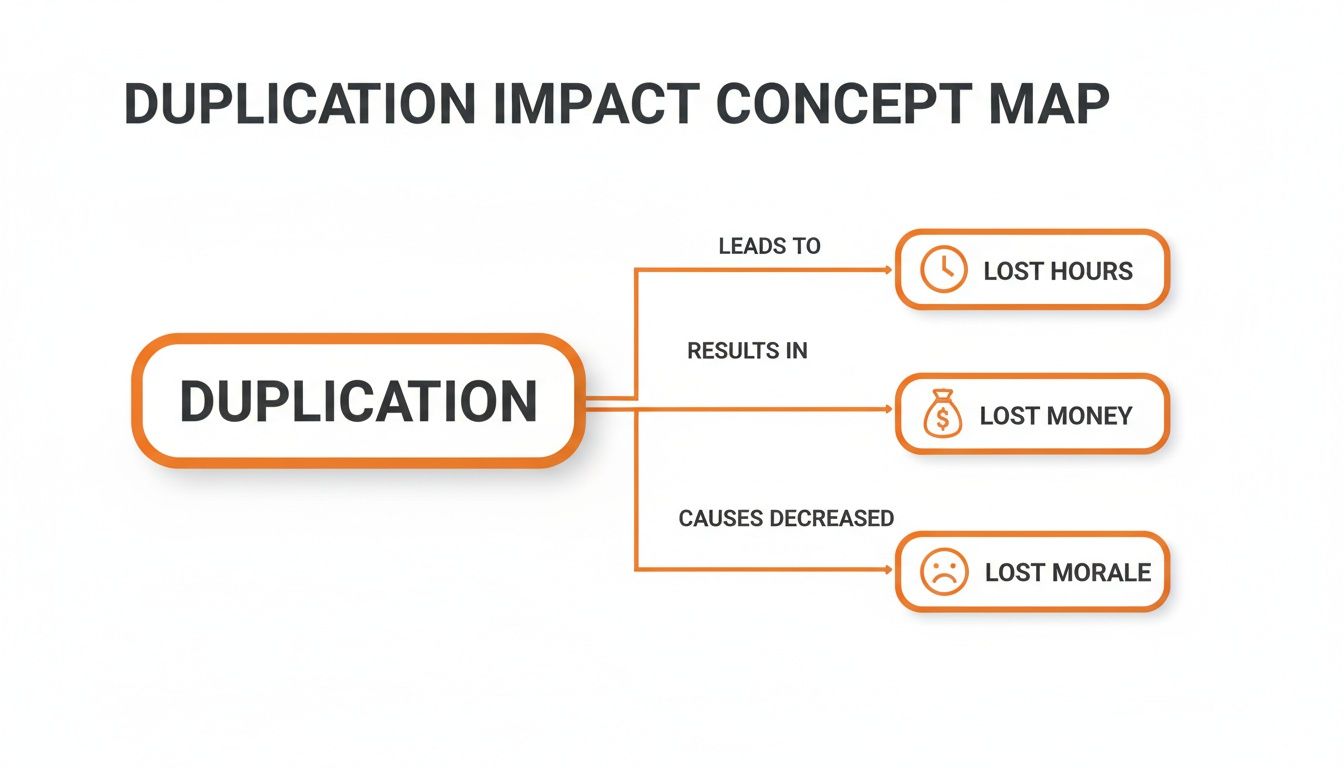
You know that sinking feeling? The one you get when you realize the report you just spent all morning on was also completed by a teammate yesterday. It’s more than just frustrating—it’s a huge drain on your team's potential.
This is duplication of effort, a silent productivity killer where multiple people or teams unknowingly do the exact same work. In this guide, I’ll walk you through a calm, practical framework to eliminate redundant tasks, create clarity for your team, and get back to the work that truly matters—all without adding more meetings to your calendar.
What is Duplication of Effort and Why Does It Happen?
Duplication of effort is when two or more people or teams independently complete the same task, producing a redundant outcome. It’s the marketing team building customer personas, completely unaware that the sales team built a detailed set just last quarter. It’s two developers coding the same feature because the project specs were fuzzy.
This isn’t just an occasional mix-up; it's a systemic issue with staggering costs. Research from UiPath found that workers lose nearly five hours a week to tasks they feel could be automated, with a significant portion of that time spent on work that’s already been done. You can dig into more of these findings on UiPath.com.
This wasted work isn't about people being lazy. It’s what happens in fast-moving environments when communication is fragmented and no one has a clear view of who's doing what. To fix the problem, you first have to understand what's causing it.
Most work duplication stems from three core issues:
- Ambiguous Roles & Unclear Ownership: When no one knows who is responsible for what, tasks fall into a gray area where multiple people might pick them up.
- Siloed Communication & Poor Visibility: Teams often operate in silos, using their own tools and channels. This creates invisible walls that stop information from flowing freely, making it impossible to see what others are working on.
- No Single Source of Truth: When plans, documents, and task lists are scattered across emails, chat threads, and various apps, there is no reliable place to check the status of work.
Recognizing these hidden costs is the first step toward reclaiming your team’s lost potential.
Principles to Guide Your Approach
Before diving into tactics, it helps to adopt a few guiding principles. These aren’t rigid rules but calm mindsets that make preventing duplication of effort a natural part of your workflow.
Default to transparency
The root of most duplicated work is a lack of visibility. The antidote is to make transparency the default setting for your team. This means making it easy for everyone to see who is working on what, not for micromanagement, but for mutual awareness. A common pitfall is thinking transparency requires more meetings. In reality, it’s about having a shared, central space where work in progress is visible to everyone, anytime.
Embrace "forced thoughtfulness"
At Sunsama, we believe in "forced thoughtfulness"—creating small, intentional moments to pause and plan before diving into work. This isn't about adding bureaucracy; it’s about building a simple habit of asking, "Is this the right work for me to be doing right now? Has someone already done it?" This brief moment of reflection before you start a task is your single best defense against redundant work.
Aim for clarity, not control
The goal isn't to control every action your team takes. It's to provide the clarity they need to move forward with confidence and autonomy. When team members have a clear understanding of their roles, priorities, and where to find information, they are empowered to make smart decisions on their own. This is where finding the right balance between autonomy and speed in decision-making becomes absolutely critical.
A Step-by-Step Guide to Eliminating Duplicated Work
Putting these principles into practice doesn’t require a massive overhaul. It’s about introducing a few simple, consistent habits into your team's rhythm.
Step 1: Start a daily planning ritual. Before you dive into emails and messages, take 10-15 minutes to plan your day. This personal ritual is your first line of defense against ambiguity. Ask yourself: What's my main objective today? Does this work depend on anyone else? Have I checked if this has been done before? Try it in Sunsama: Sunsama guides you through this ritual each morning, helping you pull tasks from tools like Asana and email into a single, focused plan for the day.
Step 2: Define a single source of truth for key information. Agree with your team on a designated home for specific things. This doesn’t mean one tool for everything, but one official place for each type of information. For example: All project tasks live in Trello, all final design assets are in Figma, and all long-form documentation is in Notion. This creates a predictable system where anyone can find the official version of something without asking.
Step 3: Run a bulletproof project kickoff. Never start a project with a vague email chain. Before any work begins, hold a quick kickoff to align on a simple one-page project brief. This document should clarify the goal, key deliverables, and roles (using a simple RACI chart). This brief becomes a north star that kills ambiguity from day one.
Step 4: Establish a clear work intake process. If requests land on your team's plate through a chaotic mix of Slack DMs and emails, you’re inviting duplication of effort. Set up a single, official channel for all new requests, like a dedicated form or Trello board. This creates one central queue where you can review, prioritize, and assign work with full visibility.
Step 5: Share daily priorities asynchronously. At the start of each day, have every team member share their top 1-3 priorities in a shared Slack channel. This simple, two-minute habit creates incredible visibility into who is working on what without the need for a stand-up meeting. It helps team members spot potential overlaps and offer help before anyone spins their wheels. Try it in Sunsama: Sunsama can automatically update your Slack status to reflect the task you’re currently focused on, making your work visible without any extra effort.
Step 6: Use weekly syncs to discuss roadblocks, not just status. Reserve your weekly meeting for discussing dependencies and roadblocks. Instead of going around the room for status updates (which should be visible in your project tool), ask: "What do you need from others to move forward?" This surfaces potential conflicts and alignment issues early. You can learn more about how to build this habit in our official daily planning guide.
Pro Tip: Frame it as a Process Problem, Not a People Problem When you spot duplicated work, avoid pointing fingers. Instead of saying, “Why did you do this when Jane was already on it?” try, “It looks like we had a process gap here. How can we make it clearer who owns what next time to save us all some time?” This turns the issue into a shared puzzle to solve, not an accusation.
A Nuanced Take: When is Duplication Okay?
While eliminating unintentional duplication of effort is crucial, it's worth acknowledging that not all overlap is bad. In some cases, intentional redundancy can be a strategic advantage. For example, you might have two teams independently explore different solutions to a complex problem to encourage innovation and divergent thinking. This is common in A/B testing or early-stage R&D.
The key difference is intentionality. Unplanned duplication is wasteful because it's a symptom of chaos and poor communication. Strategic redundancy, however, is a conscious choice made to explore possibilities or mitigate risks. The goal isn't to create a rigid system where no two people ever touch similar work. It’s to build an environment of such high alignment and clarity that when work does overlap, it’s because you decided it should.
How We Do It at Sunsama
At Sunsama, we are a small, fully remote team, so preventing duplication of effort is critical to our ability to work calmly and effectively. Our entire workflow is built around our own philosophy of thoughtful daily planning.
Each morning, every team member uses Sunsama to pull in tasks from various sources and curate a realistic plan for the day. This act of planning is our first checkpoint against redundant work. Then, we share our daily plans in a dedicated Slack channel. This simple, asynchronous ritual gives everyone full visibility into what their colleagues are focused on, allowing us to spot overlaps and offer support organically.
We don't have daily stand-ups. We don't have endless status meetings. Our commitment to a daily planning ritual and transparent communication within our calm productivity operating system allows us to stay aligned and avoid the frustration of doing the same work twice. It ensures that when people burn out from overwork, it's not because of systemic inefficiencies we could have prevented.
From Redundancy to Rhythm: A Calmer Way to Work
Getting rid of duplication of effort isn't about working harder or faster. It’s about creating the space to work with more intention. By bringing in a few simple habits—like a daily planning ritual and a single source of truth—you and your team can reclaim hundreds of hours.
The goal is to shift from a cycle of reactive rework to a calm, proactive rhythm where every action has a clear purpose. This frees you to focus on the work that actually moves the needle, building a more sustainable and fulfilling way of working. You can build a workflow where clarity is the default, and the first step is simply deciding your time is too valuable to be spent doing the same thing twice.
Ready to build a calmer, more focused workflow free from duplicated work? Sunsama helps you intentionally plan each day, creating the clarity your team needs to stay aligned.
Start your free 14-day trial of Sunsama today.


