To sidestep burnout at work, you have to get good at spotting the early warning signs. This means looking beyond just feeling 'tired' and learning to recognize specific symptoms before they spiral out of control.
Recognizing the Early Signs of Burnout
Burnout doesn’t just happen overnight. It’s a slow, creeping fatigue that often starts with subtle shifts in your mood and performance. It’s that sense of dread that starts to bubble up on Sunday evenings or the brain fog that makes even simple tasks feel like climbing a mountain. Catching these early whispers is your first line of defense.
And let’s be clear: this isn't a personal failure or a sign of weakness. The World Health Organization officially calls burnout an "occupational phenomenon" that comes from chronic, unmanaged stress at work. When you understand the key indicators, you can take a clear-eyed look at your own situation and step in before burnout takes over completely.
The Three Core Dimensions of Burnout
Burnout usually shows up in three main ways. If you start noticing these, it’s a good time to pay attention.
- Emotional Exhaustion: This is that deep-down, bone-tired feeling of being completely drained, both mentally and physically. It’s when you clock out feeling like you have nothing left to give—not to your family, your hobbies, or yourself.
- Cynicism or Detachment: Sometimes called depersonalization, this is when you start feeling negative, cynical, or just plain disconnected from your job. You might find yourself mentally checking out of meetings you used to find engaging or losing the spark that once made you passionate about your career.
- Reduced Professional Efficacy: This is a creeping doubt in your own abilities. You start to feel incompetent, like you’re not making a real impact, and you find it almost impossible to celebrate your wins, no matter how big or small.
Burnout is sneaky. It often disguises itself as just a "rough patch" until it's got its hooks in deep. Learning to tell the difference is how you shift from feeling like a victim of your circumstances to becoming the architect of your own well-being.
To help you get a clearer picture of where you stand, take a moment to reflect on your own experiences with this self-assessment.
Burnout Symptoms Self-Assessment
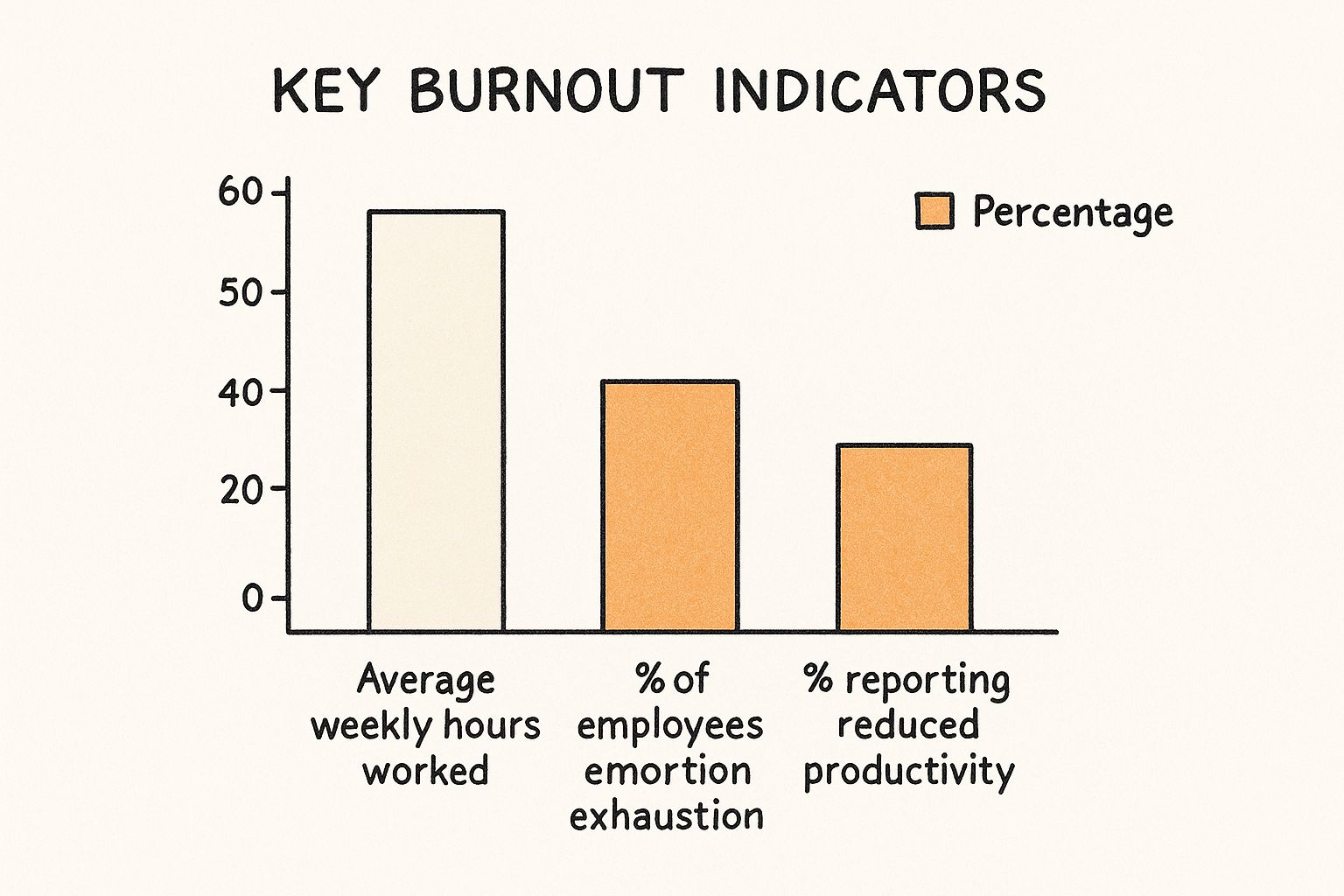
This data paints a clear picture: as work hours climb, so does exhaustion, while productivity takes a nosedive. It's a textbook case of the diminishing returns of overwork.
Unfortunately, these feelings are becoming the norm in the modern workplace. The problem has ballooned, with recent studies showing that 82% of employees globally are at risk of burning out. The crisis is especially sharp in places like the UK, where 79% of employees report burnout symptoms, and the US, where a staggering 77% of workers say they've experienced burnout at their current job. These numbers show that burnout is less of an individual problem and more of a systemic one.
The longer you ignore these signs, the tougher the road to recovery becomes. For a deeper dive into practical solutions, check out our guide on how not to burn out from overwork. The moment you recognize you're on the path to burnout is the exact moment you get your power back to change course.
The Hidden Costs of Powering Through Burnout

We've all heard the "hustle culture" gospel: push harder, sleep less, and wear your exhaustion like a badge of honor. It tells us that true grit means grinding away, even when you're running on fumes. But what’s the real price of "powering through"? The truth is, ignoring burnout isn't a sign of strength—it's like taking out a high-interest loan on your well-being. And eventually, you have to pay it back.
Pretending everything is fine doesn't make the problem go away. It just lets the damage quietly build up in the background. Seeing these consequences for what they are is the first step. It helps bust the myth that relentless work is noble and frames taking care of yourself as a non-negotiable strategy for a long, healthy career.
The Quiet Sabotage of Your Physical Health
That feeling of being chronically stressed at work isn't just in your head. It sets off a real, physical chain reaction that can seriously damage your body over time. When you’re stuck in high-alert mode, your system gets flooded with cortisol, the primary stress hormone. A little bit is fine, but living with it day in and day out is toxic.
This isn't some vague wellness concept—it has measurable, and frankly, scary impacts. Here's how ignoring burnout slowly chips away at your physical health:
- A Weakened Immune System: Constant stress can dial down your immune response, which is why you might find yourself catching every cold that goes around or dealing with lingering infections.
- Disrupted Sleep: Burnout and bad sleep are a vicious cycle. You're too stressed to get restorative rest, and the exhaustion just fuels more stress the next day.
- Chronic Pain: Many people on the edge of burnout report nagging physical symptoms—persistent headaches, tight shoulders, stomach issues—with no clear medical cause.
These aren't just minor annoyances. Think of them as the check engine light on your car's dashboard. You can ignore it for a while, but eventually, you're headed for a breakdown.
Burnout isn't just about feeling tired. It's a state of profound exhaustion that creates real, physiological changes in your body, increasing your risk for serious, long-term health conditions.
The link between unchecked work stress and serious health problems is alarmingly direct. Burnout is tied to a 21% higher risk of cardiovascular disease and an 84% increased likelihood of developing Type 2 diabetes. It also negatively affects personal relationships for a staggering 83% of sufferers. How you manage work stress isn't just a career question; it's a critical health decision.
The Ripple Effect on Your Finances and Relationships
The damage from burnout doesn't stop with your body. It seeps into every corner of your life, from your relationships to your bank account. When you're emotionally drained and cynical, it’s almost impossible to show up for the people who matter most. Patience wears thin, and the energy needed for a real connection just isn't there.
This emotional drain often leads to friction with partners, family, and friends who can’t quite grasp the depth of your exhaustion. The same detachment you feel at your desk starts to follow you home, creating distance and misunderstanding.
Financially, the costs can be just as real, often showing up in a few key ways:
- Career Stagnation: When you're burned out, you don't have the mental bandwidth for creative ideas, strategic thinking, or going after that next big opportunity. Your performance plateaus, and you get passed over for promotions.
- Increased Medical Bills: The cost of treating burnout—from therapy sessions to doctor’s visits for stress-induced ailments—can add up quickly.
- Job Hopping: Burned-out employees are nearly three times more likely to be looking for a new job. This can lead to income instability or, worse, jumping into another bad situation out of pure desperation.
This whole destructive cycle is often fueled by a deep-seated, but misplaced, sense of obligation to keep producing at an insane pace. It's a classic symptom of what we call "toxic productivity." To learn more about this, you can read about the dangerous trap of toxic productivity in our detailed article. The first step to breaking free is simply recognizing these patterns in your own life.
Practical Strategies to Reclaim Your Workday
It’s one thing to know the signs of burnout, but it’s another to actually do something about it. Moving from awareness to action is where the real change happens. The good news is that you don't need a massive, life-altering overhaul to get back on track.
Regaining control of your workday is about building a set of small, practical habits. Think of it as creating a strong defense against stress and overcommitment, one small move at a time. These are strategies you can start using today to shift your daily grind from draining to manageable—and maybe even fulfilling again.
Redefine Your Relationship with Time
A huge part of burnout is that sinking feeling of your to-do list growing while the clock just keeps ticking. It feels like you’re losing control. The way to fight this is to get intentional about how you structure your day. This isn't about working more—it's about working smarter.
One method I've seen work wonders is the Pomodoro Technique. You work in focused 25-minute bursts, then take a short break. It's deceptively simple, but it breaks overwhelming projects into bite-sized pieces and keeps your mind from turning to mush.
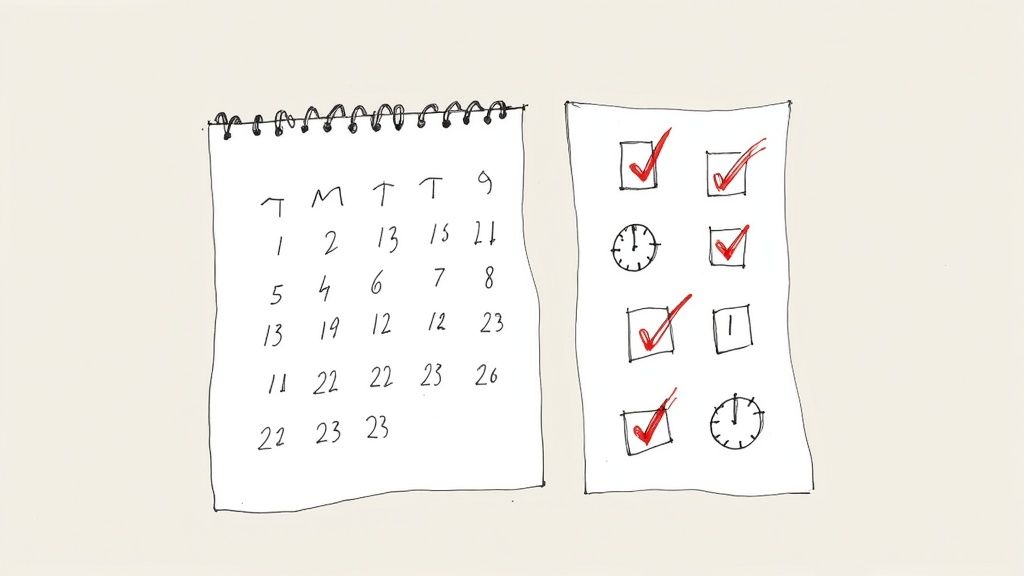
Another powerful approach is time blocking. Instead of having a free-floating to-do list, you schedule your tasks directly onto your calendar. You're treating your focus like a VIP meeting that can't be interrupted. This is how you protect your most valuable resource from the constant stream of pings and "quick questions."
Set and Enforce Clear Boundaries
If you don't set boundaries, work will expand to fill every available moment. It's a fast track to that "always on" feeling that fuels burnout. Setting firm boundaries is one of the most powerful things you can do, but you have to stick to them.
Learning to say 'no' is a survival skill here. It's not about being difficult; it's about protecting your ability to deliver high-quality work on what you've already committed to.
Saying 'no' can feel uncomfortable at first, but it’s really an act of self-respect. It signals that you value your time and energy, and it prompts a much-needed, realistic conversation about priorities.
When your plate is full, you can decline new requests professionally. Here are a few lines I've used myself:
- "My current workload means I can't give this the attention it deserves right now. Can we revisit it next week?" This is firm but shows you're still engaged.
- "I can't take this on, but I'm happy to help you think through who else might be a good fit." You're declining, but you're still being a supportive teammate.
- "To take on this new task, I'd need to push back either X or Y. Which one should I de-prioritize?" This makes the trade-offs clear and puts the ball back in their court.
Create a Shutdown Ritual
The line between "work mode" and "home mode" gets incredibly blurry, especially when working remotely. A shutdown ritual is a non-negotiable routine you do at the end of every workday to tell your brain, "We're done here."
It doesn't have to be complicated. Your ritual could be as simple as this five-step process:
- Review what you actually got done today.
- Plan your top 2-3 priorities for tomorrow.
- Tidy your desk or close out your digital workspace.
- Close every single work-related tab and application.
- Say something out loud, like, "And that's a wrap."
This simple routine creates a clean break, helping you mentally clock out and be fully present in your personal life. It's a small habit with a huge impact on maintaining work-life separation. Protecting your off-hours is a core part of learning the best ways to manage your energy throughout the workday. By building these intentional habits, you create a sustainable framework that supports both your productivity and your well-being.
Designing a Sustainable Work-Life Integration
The old idea of "work-life balance" feels like an impossible tightrope walk, doesn't it? A much more realistic goal is work-life integration. This isn't about separating work and life into neat, equal boxes. Instead, it’s about creating a flexible, sustainable rhythm where your professional and personal lives can coexist—and even support each other—instead of constantly fighting for your attention.
This approach gets that modern work, especially remote work, rarely fits into a clean 9-to-5 container. The trick is to build intentional structures that fiercely protect your personal time and mental energy. That's how you prevent the "always on" pressure that leads straight to burnout.
Treat Personal Time Like a Client Meeting
Here's one of the most effective shifts I've seen people make: give your personal time the same respect you give professional commitments. Think about it. A client meeting is a non-negotiable entry on your calendar. Why shouldn't your evening downtime, a hobby, or family dinner be just as sacred?
Start by scheduling your non-work activities with real intent. Block out time for:
- Hobbies and interests that genuinely fill your cup, whether it’s hitting the gym, reading a book, or just tinkering with a side project.
- Dedicated rest periods where you are intentionally not productive. This isn't just "not working"; it's active recovery.
- Social connections with friends and family that aren't squeezed into the last few minutes of your day.
When you see "Guitar Practice" or "Dinner with Partner" on your calendar, treat it like a hard deadline. This simple mindset shift helps you build a life that feels full and balanced, not one completely dominated by your job. To get a more harmonious schedule dialed in, you might find some good ideas in our expert tips for work-life balance.
The Critical Need for Mental Detachment
Closing your laptop at 5 PM doesn't mean your brain has clocked out. Mentally detaching from your job is a skill, and it's one you have to practice deliberately. Without it, you can be physically present with your loved ones but mentally still wrestling with work problems—a fast lane to digital exhaustion.
The stats on workplace stress are a flashing red light. A 2023 report found that a staggering 75% of employees worldwide feel at least moderate stress at work. The main culprits? Heavy workloads, long hours, and a packed meeting schedule. These pressures don't just disappear when you log off.
Burnout rates also hit some people harder than others. Women report higher burnout than men (46% vs. 37%), and remote workers often report higher rates of loneliness. The data makes it clear: burned-out employees are 3.4 times more likely to start looking for a new job, proving that protecting mental health isn't just a nice-to-have, it's a business necessity. Creating a clean mental break is your best defense against this downward spiral.
Tailoring Your Approach to Your Life
There’s no one-size-fits-all playbook for avoiding burnout. Your ideal work-life integration will look completely different based on your job, your personality, and your current life stage. A recent grad at a fast-paced startup has different needs than a working parent with two kids at home.
The goal isn’t to find a perfect, static balance. It’s to build a resilient, personalized system that you can tweak as your life and career evolve. True sustainability comes from flexibility.
By ditching the rigid idea of "balance" for a more fluid "integration," you can design a work life that actually fuels your personal life, and vice versa. This proactive approach is your strongest defense against the chronic stress that leads to burnout, helping you build a career that’s both successful and sustainable for the long haul.
Creating Your Personal Burnout Prevention Plan
Alright, we’ve talked about what burnout looks like and why it's so costly. Now for the most important part: building a practical, personalized playbook to keep it from taking over your life.
This isn't about finding some magical fix. It’s about creating a sustainable, long-term strategy that keeps burnout from ever gaining a real foothold. Think of this plan as your compass—something to guide you back to stable ground when work starts to feel like a storm. It's a living document, meant to be tweaked as your job, life, and priorities inevitably change. The real goal here is to shift from constantly putting out fires to proactively managing your workload and well-being.
Identify Your Primary Burnout Triggers
Before you can build up your defenses, you have to know what you’re up against. Your burnout triggers are deeply personal; what sends one person into a stress spiral might actually energize someone else. So, it's time for some honest reflection.
Think back to the last few times you felt utterly drained, cynical, or just plain over it at work. What was going on?
- Was it a relentless, crushing workload with impossible deadlines?
- Did you feel like you had no control over your projects or your schedule?
- Was there a nagging sense of being unappreciated or undervalued for your efforts?
- Or was it the constant stream of pings and interruptions that shattered your focus every day?
Try to pinpoint your top 2-3 triggers. Getting specific is key. For example, maybe you realize that vague project briefs from your manager are a huge source of stress, or it’s the unspoken pressure to be online and answering emails late into the evening. This clarity is the foundation of your plan—it will help you pick the strategies that will actually make a difference for you.
Choose Your Go-To Prevention Techniques
Once you know your triggers, you can start cherry-picking strategies that directly counter them. You don't need to do everything at once. In fact, you shouldn't. The key is to choose a few techniques that feel achievable and resonate with you personally.
For instance, if your biggest trigger is an overwhelming workload, your go-to moves might be:
- Time blocking to carve out and protect sacred time for deep work.
- Using simple scripts to politely say 'no' to requests that aren't a priority.
- Committing to a hard stop with a strict shutdown ritual at 6 PM every single day.
If your trigger is feeling ineffective or like you're just spinning your wheels, you might focus on tracking your small wins or scheduling regular check-ins with your manager for feedback. The idea is to build a small, powerful toolkit of habits that directly address your personal pain points. Feeling overwhelmed by these triggers is often what leads to procrastination, and learning why we can't stop procrastinating can offer even more insight.
Build a Weekly Check-In Habit
A plan is completely useless if it just sits in a document somewhere. To make your burnout prevention strategy actually stick, you have to build a routine around it. A weekly check-in is a simple but incredibly powerful way to monitor your stress levels, adjust your plan, and stay on course.
Your weekly check-in isn't just another chore to add to your to-do list. Think of it as a brief, non-negotiable meeting with yourself to make sure your well-being stays at the top of the agenda.
Set aside just 15-20 minutes every Friday afternoon to look back on your week. This gives you a moment to breathe and reflect before heading into the weekend.
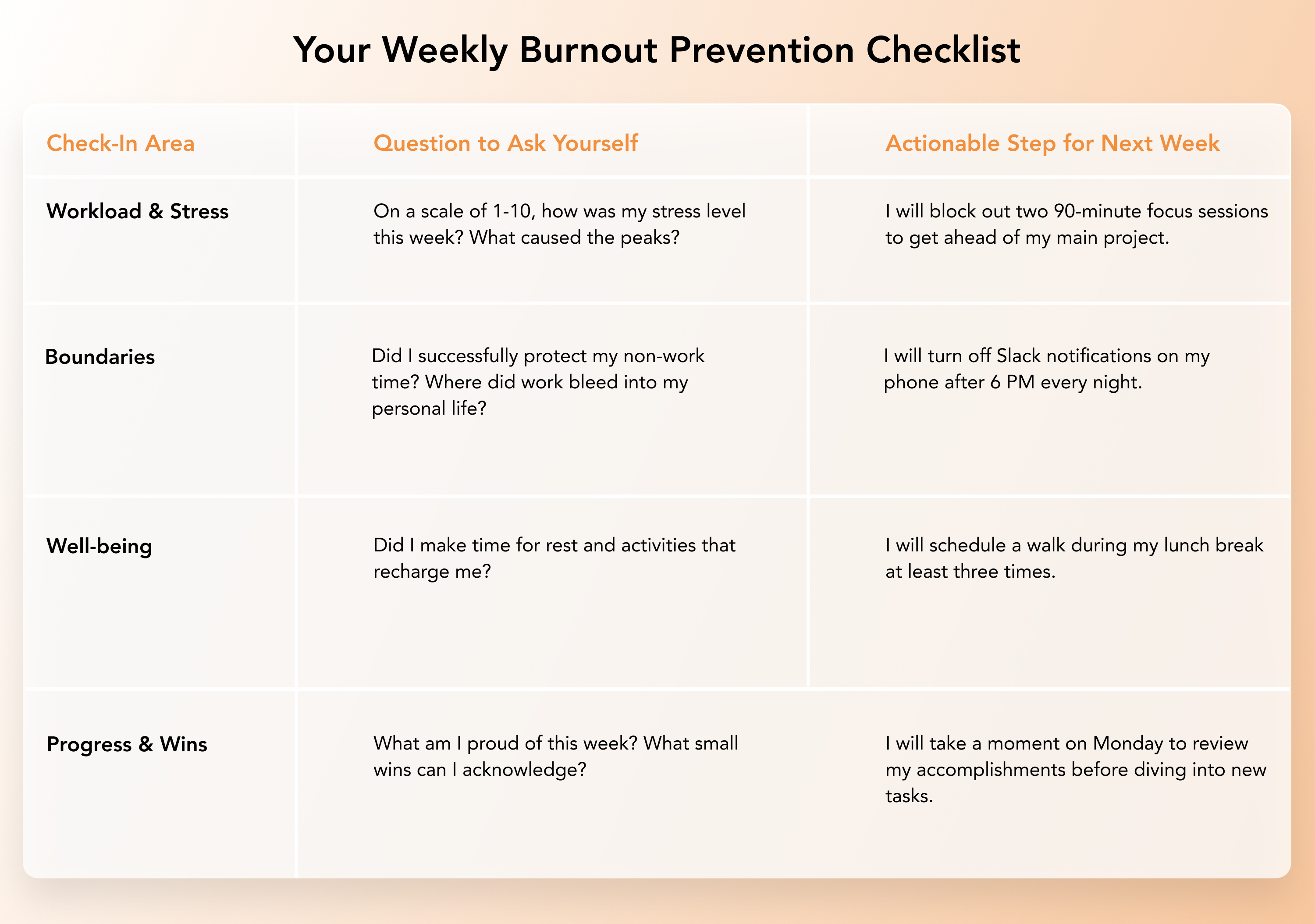
Your Weekly Burnout Prevention Checklist
Here's a simple table you can use to guide your reflection. The goal is to build a habit of checking in with yourself about your workload, boundaries, and overall well-being.
This kind of regular self-assessment is what transforms burnout prevention from a one-time fix into an ongoing, dynamic practice. It gives you real data to make small, consistent tweaks—and that, right there, is the secret to building a resilient and sustainable career.
Got Questions About Preventing Burnout? You're Not Alone.
Even with the best intentions, putting a plan in place to fight burnout can feel… tricky. It's one thing to read about strategies, but it's another thing entirely to put them into practice in the real world.
You might be asking yourself if what you’re feeling is even “bad enough” to be called burnout. Or maybe you're wondering how to bring it up with your boss without just sounding like you're complaining. These are completely normal questions, so let’s get into some real answers.
What’s the Real Difference Between Stress and Burnout?
This is a critical distinction to make. Think of stress as that feeling of drowning—it’s intense, overwhelming, and you feel like you have way too much on your plate. You're struggling, for sure, but you still have a sense that if you can just get through this one crunch period, you’ll be able to come up for air. You still believe you can tread water.
Burnout, on the other hand, is what happens after you’ve drowned. It’s a state of being completely hollowed out, emotionally numb, and just… spent. The defining feature is a deep sense of hopelessness; you no longer believe your efforts make any difference at all. Stress is defined by over-engagement, while burnout is defined by total disengagement.
A stressed employee might be frantic and working furiously to catch up. A burned-out employee is often detached, cynical, and has simply stopped trying to keep their head above water.
Knowing the difference helps you spot when you've crossed the line from a tough patch into a genuine occupational crisis.
How Can I Talk to My Manager About Burnout?
This conversation can feel really intimidating, but framing it constructively is the secret. The goal is to talk about workload and solutions, not just feelings. You want to avoid any language that sounds accusatory and instead focus on your shared goal: being able to do your job well.
First, schedule a dedicated time to talk—don't try to squeeze this into a hallway chat. Come prepared. You could say something like, "I'm really committed to my work here, but I've realized my current workload isn't sustainable and it's starting to impact my output. Could we take a look at my projects and strategize on priorities?"
This approach does a few important things:
- It frames you as a proactive, solution-focused member of the team.
- It gives the conversation a concrete, business-focused starting point.
- It opens the door for a collaborative discussion about what’s realistic.
What If My Company Culture Is the Problem?
This is the toughest one. If the entire company culture is built on unreasonable hours, a constant lack of appreciation, and a toxic "always-on" mentality, individual strategies can feel like trying to fix a sinking ship with a roll of duct tape. You can’t change an entire organization by yourself, but you can take steps to protect your own sanity.
First, get laser-focused on what you can control. This means your personal boundaries, your shutdown rituals, and how you organize your own tasks. Become fiercely protective of your time.
Second, start documenting things for your own clarity. Keep a private log of extra hours you're putting in or specific examples of unreasonable requests. This isn't about building a case for a big confrontation; it's for you. It gives you a clear picture of reality and can help inform your next career move.
Ultimately, if the culture is fundamentally at odds with your well-being, the most powerful burnout prevention strategy might be to quietly and strategically plan your exit. No job is worth sacrificing your health for.
Ready to stop juggling endless to-do lists and start working with intention? Sunsama helps you build a calm, sustainable workday by organizing your tasks, calendar, and emails in one place. Start your free trial today and discover a better way to work.